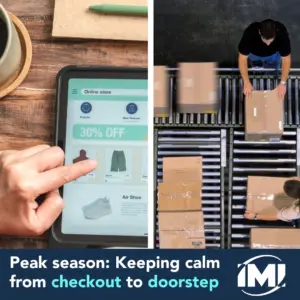
Peak season: Keeping calm from checkout to doorstep
By Niklas Danielsson, Business Unit Director at IMI Supply Chain Solutions
For many retailers, peak season is when a large share of annual profit is made. Every part of the operation – the checkout, the warehouse, the carriers and customer communication – is under pressure at the same time to compensate for higher volumes. With so much order value at stake, all systems need to run smoothly and efficiently to ensure orders keep moving from checkout to doorstep even when demand fluctuates.
The shape of peak has changed over the last 20 years, with Black Friday stretching into more of a season. The busy period now runs for a month or more as shoppers snap up deals in early November, a pattern that is especially visible in the Nordics but also extends to the rest of Europe. Across markets, the extended sales period means retailers need to manage elevated order volumes over a longer period rather than preparing for a single peak weekend.
As consumer behaviour develops each year, retailers should be looking harder at how much value peak season is bringing their business and whether operations are designed to manage this flow of steep orders to avoid strain on the warehouse and delivery networks.
Peak planning
Most retailers can forecast peak well by now. They know roughly when demand will arrive and how large it will be, although there is variation year on year as buying trends fluctuate. The harder part for retailers is how they respond when the rush arrives, especially when demand runs ahead or behind predictions.
Preparation starts with the technology. In the run-up to peak, retailers should stress test their systems at high volumes, end to end, from the checkout through to the warehouse and shipping, to make sure everything holds up if demand exceeds expectations. A peak week is the worst possible time to find out that a new release or configuration change has slowed down order processing, and a service interruption during peak is a business disaster that trumps Santa not arriving on Christmas Day.
Making the delivery promise realistic
The delivery date shown at checkout is a promise to the customer, and businesses can find this difficult to keep in peak season. In many set-ups, that delivery date is calculated separately from what is happening in the warehouse. Picking and packing take longer during peak, so lead times need to change with the season.
Keeping the delivery promise to customers means keeping everyone informed. Parcel delivery problems can quickly affect the customer experience, particularly when networks are under pressure during peak. When a delivery is going to be late, customers need to hear what has happened, why, and when to expect it. Updates at every stage, from placing the order to delivery, keep customers reassured and stop customer service teams being swamped with questions at the busiest time of year.
Implementing plan B
Every retailer needs a plan B for when a carrier reaches capacity. Carriers expand their capacity ahead of peak, yet the run-up still puts delivery networks under strain. Adding another carrier option at checkout is a common choice, but this only works when the warehouse can book and ship with that carrier too, and the customer can see and choose it at checkout.
This is where things often come unstuck. The warehouse may be run by a third-party logistics provider or a separate part of the business, while the e-commerce team looks after the website. When each part of the flow sits with a different team, or a different software partner, a change that should be quick needs several parties to coordinate – and time is in short supply during peak.
Over the years, many retailers have taken a best-of-breed approach, choosing separate software for each part of the process. Each system may perform well in its own area, yet together they can leave the overall flow sub-optimised. A connected suite from one partner, covering delivery options at checkout, order management, the warehouse, shipping and customer visibility, gives retailers control over the whole flow. That control is what allows them to make changes quickly when demand exceeds expectations.
Using reverse logistics to drive customer loyalty
Peak brings high return rates, especially in industries like fashion. Customers need to try sizes and styles, and sending items back is the online equivalent of the fitting room. Retailers focused on cutting returns at all costs can risk damaging loyalty they have worked hard to build.
What maintains this loyalty is a smooth process: easy returns for the customer and efficient handling in the warehouse. Some retailers have started charging for returns, and while everything has a place there needs to be a balance. A customer who orders every item in five sizes and sends nearly all of it back is a cost any retailer will want to manage. One potential approach is setting different rules for different customers. High-value, returning customers might keep free returns through a loyalty programme, while new customers can pay for returns until they become regular buyers. Knowing which customers to keep, and treating them accordingly, can turn the returns policy into a loyalty tool.
Ready for the rush
As each year brings an increase in peak pressure, retailers are becoming more selective about how they approach the season. Some are scaling back deep Black Week discounts, others are spreading demand across several months, and many now judge the season on profit as well as volume.
Whatever the strategy, the orders that do come in need to reach customers on time, with a delivery promise the business can keep. That depends on the checkout, warehouse, carriers and customer updates working as one, tested and ready before the first peak order lands.
Some of the brands relying on IMI












IMI Supply Chain Solutions